Is your child ready for the
worldview challenges of college
level introductory psychology?
What We Do

We are an experienced home
schooling family.  The oldest of our
four children was home schooled K-12
and is now a college sophomore.

Dr. Tim

I have worked for the past 13 years in a
public mental health center. Twenty
years ago, as a young Christian, I  took
Introductory Psychology at the
University of Georgia. I was not
prepared to recognize the humanist,
evolutionist, and naturalist
assumptions material embedded in
the  theories. Homeschool Psych:
Preparing Christian Homeschool
Students for Psychology 101 is the
result of my effort to understand how
psychology fits with my Christian
worldview and to assure that my
homeschool students are prepared for
Psychology 101.

Contact Dr. Tim @
tim@homeschoolpsych.com


Tina

I felt God’s calling in my life over 18
years ago to stay home and  educate
my children. It has been a blessing, a
reward, and a challenge. I wouldn't
have it any other way!

One of the biggest challenges I’ve
faced is finding top quality curricula
that reflect my Christian beliefs. Over
the years I have reviewed so many that
now, in my “spare time” I review
homeschool materials for the Old
School House magazine. In all my
years of homeschooling, I have never
seen anything to help prepare
homeschool juniors and seniors for
the challenges of college-level
introductory psychology. I’m very proud
of Tim’s effort and I think you will find
his work helpful as you prepare your
homeschoolers for the challenges they
will face in college.

I grew up in the San Francisco Bay
Area and have always LOVED tie-dyed
clothing. After my daughter received a
tie-dye kit several years ago, I was
hooked. Now I have started Tina’s Tie-
Dye. My goal is to make beautiful, high
quality, hand dyed clothing, gifts, and
accessories.
Click the link to see some of my work.

Tina's Tie Dye
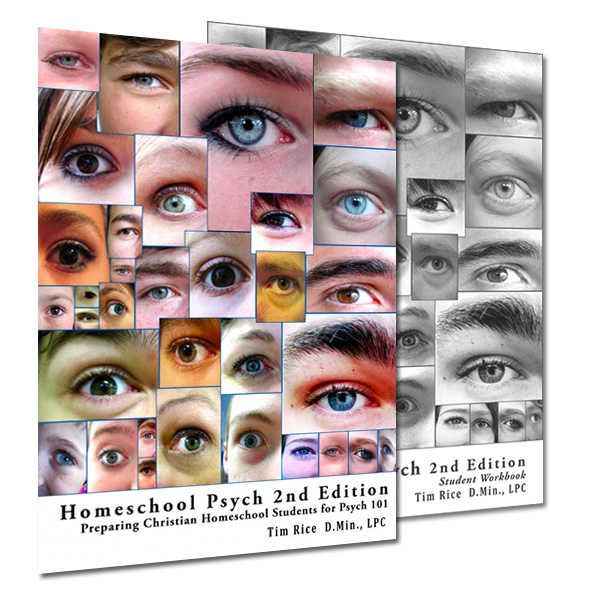
Homeschool Psych:
Preparing Christian Homeschool
Students for Psychology 101
Dr. Tim Rice
$29.95 plus shipping.

Homeschool Psych:
Student Workbook, Quizzes
and Answer Key
$14.95 plus shipping.
Homeschool Psych: Preparing Christian Homeschool Students
for Psychology 101
By Tim Rice D. Min.
Table of Contents

Chapter 1

What is Psychology?  *  The Extent of Psychology   *   A Christian Approach to Psychology   

Chapter 2

Components of a Christian Worldview   *   The Development of Modern Psychology: View of God – Theism or
Naturalism   *   The Development of Modern Psychology: View of God – Darwinian Evolution   *   The Development
of Modern Psychology: View of God – Atheism     

Chapter 3

The Development of Modern Psychology: View of Mankind   *   The Development of Modern Psychology: View of
Mankind – Sigmund Freud   *   The Development of Modern Psychology: View of Mankind – Behaviorism   *   The
Development of Modern Psychology: View of Mankind – Reductionism   *   The Development of Modern
Psychology: View of Mankind – Humanism   *   The Development of Modern Psychology: View of Mankind –
Selfism        

Chapter 4

The Development of Modern Psychology: View of Knowledge   *   The Development of Modern Psychology: View of
Knowledge – Faith/Science Dichotomy   *   The Development of Modern Psychology: View of Knowledge – All Truth
is God’s Truth   *   The Development of Modern Psychology: View of Knowledge – General and Natural Revelation   
*   The Development of Modern Psychology: View of Knowledge – Empiricism   *   The Development of Modern
Psychology: View of Knowledge – Bias and the Noetic Effect of Sin        

Chapter 5

The Development of Modern Psychology: View of Right and Wrong – Moral Relativism   *   View of the Causes of
and Cures for Mental Pain   *   View of the Causes of and Cures for Mental Pain: Sin   *   View of the Causes of and
Cures for Mental Pain: Counseling   *   View of the Causes of and Cures for Mental Pain: Criticisms of
Counseling     

Chapter 6

Modern Psychology: History   *   Modern Psychology: Structuralists   *   Modern Psychology: Functionalists   *   
Modern Psychology: Behaviorism   *   modern Psychology: Freud   *   Modern Psychology: Humanism   *   Modern
Psychology: Cognitivism   *   Modern Psychology: Neuro-biology        

Chapter 7

Modern Psychology: The Biological Components   *   The Brain   *   The Brain: The Cerebrum   *   The Brain: The
Cerebellum   *   The Brain: The Medulla   *   The Brain and Behavior   *   The Brain and Behavior: Brain Injury   *   
The Brain and Behavior: Brain Stimulation   *   The Brain and Behavior: Brain Imaging   *   Basic Units of the
Nervous System:  Nerves   *   The Peripheral Nervous System        

Chapter 8    

Sensation and Perception   *   The Visual System   *   The Auditory System   *   The Olfactory System   *   The
Gustatory System   *   The Cutaneous System   *   The Kinesthetic System   *   Extrasensory Perception and
Paranormal Psychology        

Chapter 9

Learning       
Learning: Classical Conditioning   *   Learning: Operant Conditioning   *   Operant Conditioning: B. F. Skinner        

Chapter 10

Consciousness   *   States of Consciousness   *   Sleep   *   Dreams   *   Meaning of Dreams   *   A Christian View
of Dreams   *   Hypnosis   *   Hypnosis: A Christian View?   *   Meditation   *   Psychoactive Drugs   *   Depressants:
Alcohol   *   Depressants: Sedative-Hypnotics   *   Stimulants   *   Stimulants: Caffeine   *   Stimulants:
Amphetamine & Methamphetamine   *   Stimulants: Cocaine   *   Stimulants: Nicotine   *   Opiates   *   
Hallucinogens   *   Marijuana        

Chapter 11

Language   *   Cognition   *   Cognitive Development       

Chapter 12

Personality   *   Personality Tests   *   Theories of Personality: Sigmund Freud   *   Theories of Personality: Carl
Jung   *   Theories of Personality: Alfred Adler   *   Theories of Personality: Albert Bandura   *   Theories of
Personality: Carl Rogers   *       
Abnormal Psychology   *   Classifying Mental Illnesses   *   Treatment   *   Integrating Psychology and a Christian
Worldview?        

Chapter 13

Research Methods        
From the Introduction

Psychology is one of the most controversial and divisive academic subjects among Christians today. If you
have never considered introductory psychology, your Christian worldview, and homeschooling in the same
thought, do it now. Ask yourself if psychology has a place alongside biology, chemistry, and physics in your
homeschool and consider how psychology fits (if it fits at all) with your Christian worldview.  

Some Christians accept psychology wholesale, some reject it entirely, and some wrestle with which aspects
to accept and which to reject. Some Christians view psychology as an important academic discipline,
consistent with a Christian worldview, and worthy of study. Others view psychology as an idolatrous and
ungodly rival religion. Some describe it as “psychobabble,”  “psycho-heresy,” and the most deadly form of
modernism to ever confront the Church. Whatever you believe about psychology, the time to address
academic psychology is BEFORE your student leaves home for college.   

If your student goes to college, there is an excellent chance he/she will take an introductory (at least)
psychology course. Christian students are often ill prepared to confront the criticisms of Christianity and the
anti-Christian worldview presented by modern psychology. The material taught in introductory psychology
courses WILL challenge their worldview.  University level instruction in modern psychology is generally
atheistic and humanistic. Psychology departments often are home to the most anti-Christian intellectuals on
college campuses. As a group, psychology professors have high levels of agnosticism, skepticism, and
atheism.  The psychology professor is unlikely to be sympathetic to your child’s Christian worldview and may
attack their faith as unscientific, irrational, prudish, exploitive, controlling, inhibitive, oppressive, and naïve.

Your students are probably well prepared to defend their faith and well prepared to directly refute humanism,
evolutionism, empiricism, determinism, relativism, reductionism, and naturalism (the core philosophical
assumptions of modern psychology). HOWEVER, in introductory psychology classes, those core
assumptions are often subtle and difficult to recognize and presented under the banner of “science.”

Failing to recognize anti-Christian assumptions embodied in a psychological theories may lead Christian
students to accept ideas that are inconsistent with a Christian worldview. Psychology courses, even in
Christian colleges and universities, rarely distinguish philosophical assumptions from science. C. S. Lewis
once observed that Christian faith is not very likely to be shaken by a book on an alternate worldview (Lewis,
1952). But if that worldview were embedded in books on Biology, Politics, Astronomy, or Psychology, that
might shake us.  

Secular humanistic philosophies, common in colleges and universities, influence Christian students and
many Christians walk away from their faith during college.
Christian students in higher education face direct challenges from straightforward anti-Christian teaching and
subtle challenges from anti-Christian assumptions integrated into otherwise benign material. The subtle
danger remains strong if homeschoolers fail to address an entire academic discipline (psychology) by
wrongly equating the discipline with its modern underlying assumptions.

The goal of Christian education, in biology, history, theology, the arts, and in psychology, is to understand God’
s creation and, in the words of Johannes Kepler, to “think God’s thoughts after Him.” As Christians assert a
Christian worldview in the university, asserting that worldview in psychology is appropriate and timely.
Christians have a duty to reclaim the whole culture and Christian homeschoolers have an opportunity to lead
that effort. The involvement of homeschoolers in the study of psychology is an integral part of that effort.

This text was developed for Christian homeschoolers as a prerequisite to college–level introductory
psychology and is intended to help prepare student to think Christianly about psychology’s concepts, and
more importantly, its underlying worldview assumptions. This text examines the Christian criticisms of
psychology and explains the pitfalls students face in university study of psychology but does not accept that
those pitfalls are justification for rejecting the entire academic discipline. Instead, this text suggests that the
study of the soul, the mind, and behavior are right and proper for Christians and that Christian students
should join the contemporary psychological conversation and become part of the future intellectual
leadership of in psychology.

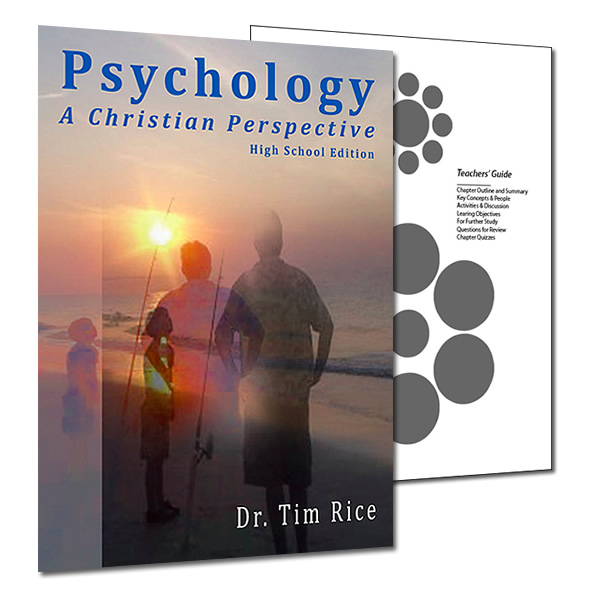
Section I is intended to help prepare Christian homeschoolers for the worldview challenges of modern
psychology. Section II is an overview of key concepts commonly taught in introductory psychology and
provides opportunities with which your student can study psychology more deeply.
Order Homeschool Psych
Email Dr. Tim
Homeschool Psych
Blog
Order Homeschool Psych
Children's Books

Daniel Rice has written a
children's book titled
The Iron
Blade
and
Abigail Rice has written a
children's book titled
Peter and
Spot.
Click here to find out more about
these books and how to order
them.

Click here for
Children's Books